Showing posts with label Hanoi. Show all posts

Thursday, February 7, 2013

ICE wins prize for VNTA Headquarter

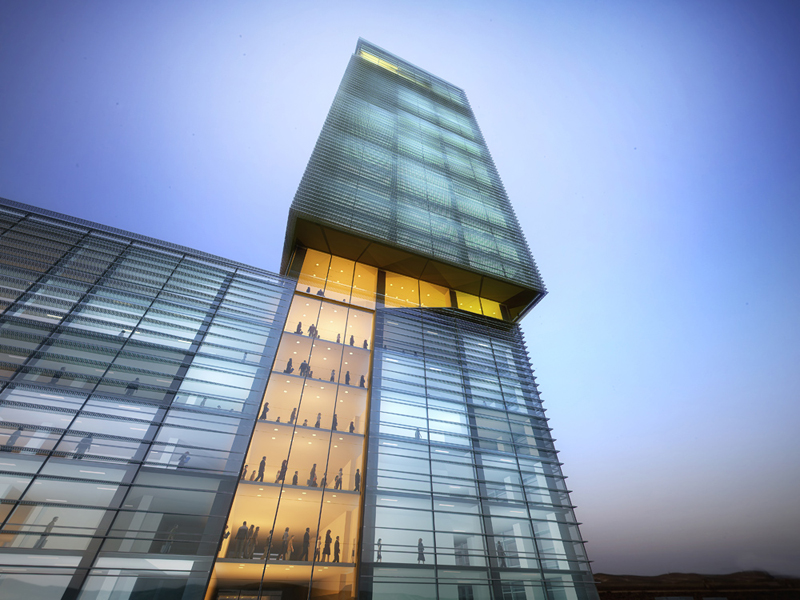
It has been a while ago since we won an award for our entry to the international invited competition for the new VNTA Headquarter in Hanoi, Vietnam. VNTA is the telecommunication authority of Vietnam. We were invited last year to participate in this competition with international large scale firms with us remaining one of the last three finalists. In the attached picture our model is to the right (downloaded from the internet, not really representing the model in its details).


After seeing the final judging results we realized that the client had a choice between two very similar schemes (ours was one of them). Yet our muscles are limited compared to the muscles of one of the largest architectural practice in the world which won the project.

What this competition revealed to us is that we either compete on that level in terms of investment beyond the project and design or we shift to boutique style small scale projects. As the later decision would defeat the purpose of the setup of our company in the first place. Hence we are currently struggling about which way to go further with dignity and integrity. It is a long way to go still...


Team ICE: Ulrich Kirchhoff, Louise Low, Minh Le Van, Claudia Wigger, Matteo Biasiolo, Jorge Gil
Environmental: Cundall
Local Architect: Trinity
Renderings: Lifang

© 2013, ice - ideas for contemporary environments


Saturday, January 21, 2012

2012 - Enter the Dragon

2011 has ended rather busy and hectic. Consequently the blog has been fairly quiet also. As our operations are running on the East Asian Calendar, we wish a Happy New Year to all our readers, friends, colleagues and clients.

We are closing on an extremely successful year with a lot of groundbreaking developments.

Foremost we have hit 30,000 readers of this blog within the first two years of posting. Thank you so much for all the support and encouragement in our work.

Additionally we won the five star AsiaPacific Property Award this year, beating other peers of the profession. Currently we are designing the latest high rise in Hanoi, working on several master plans in Vietnam, a groundbreaking high rise in Hong Kong and multiple large scale interior projects for multinational companies in China. And on top of it we diversified into product design with a revamp of COATS product displays worldwide.

We are proud to do all this with an extremely flexible, yet small task force, defining the agenda for the office in 2012: Small is successful!


Thursday, October 13, 2011

Radical Mix @ Swissnex

We were recently invited to give a talk at the Swissnex in San Francisco as part of the opening of the Travel Exhibition "3 Positions". Introducing the Radical Mix studio, we gave a brief introduction to the evolution of the challenges of the contemporary city and compared the conceptual modernist approach with the spontaneous and impulsive growth of the asian cities:

Vertical Urbanism - A Brief History

To understand where we are, we need to know where we come from. I will begin by revisiting the Plan Voisin by Le Corbusier, a century old, and the evolution of the model in the West and in Asia. The Modernist answer to the question of sustainability at that time.

In the West, vertical cities are envisioned in Order, with impeccable blocks meticulously aligned over a pristine site. Le Corbusier foresaw a shiny city, the vast population secured in airy towers, with Nature flourishing below. A neat rectilinear network of skyscrapers crosshatched with wide highways for automobiles, freeing the podium for manicured parks.

The story of Pruitt-Igoe:

Architect Minoru Yamasaki
Completed in 1956, St. Louis, Missouri, USA

2,870 apartments in 33 apartment buildings on 23 hectares.
Based on the principles defined by CIAM, blocks were raised up to 11 floors to save the grounds and ground floor space for communal activity. The buildings remained largely vacant for years, occupancy never rose above 60%. By the end of the 1960s Pruitt–Igoe was nearly abandoned and had deteriorated into a decaying, dangerous, crime-infested neighborhood

Demolition - 1972-1976


The story of Vele di Scampia (Sails of Scampia):

Architect Franz Di Salvo
Built 1962-1975, Scampia, Naples, Italy

The design with bridges, corridors and sky communal spaces represented the paradigm of a new approach to the social residence. The idea behind the project was to provide a huge housing settlements where hundreds of families can integrate and create a community.

The Sails of Scampia became a major centre for drug trafficking and illegal activities. The buildings are in a state of decay, while two buildings are still occupied by residents. The 2008 film Gomorrah of Matteo Garrone was partly filmed here.

The towering projects speak of a social division, of a life trapped in cages up in the air, overlooking the violence and the void of existence below, peering at the gathering storm of riot police and youths in the streets.

Whereas Asia resembles a Darwinian Architectural experiment in overdrive that bloomed a thousand species.

Le Corbusier did not foresee that the humanity stacked up in his immaculate cruciforests will burst from their fortresses into the free-flowing ground below, hungry for the liberation from the immobility of their vertical lives, luxuriating in the flux of the streets. The towers are scalar fields, the pent-up energy in them disperses by the millions into the podium and streets where fertile mercantile imagination found thousands of ways to capture their fleeting attention, if not their wallets, stomachs, hearts and minds.

The result of the inverse relation of the towers and the streets, the Ville Ombreuse, allows a bewildering number of shadier, tenacious, adventurous lifeforms to flourish and multiply in micro-economies and macroecologies.

As an urban rhizome, connected from its skybridges to the bowels of its subway, networked to near territorial infinity by intricate metro systems and trains, they weave a matrix upon which the prosperous metropolis thrives, by-passing some of the most spectacular nature of South China, mountains, sand and sea, leaving them pristine. Its staggering monumental density belies the fact that this is an unexpectedly sustainable model for millions.

Excluding Hong Kong's high consumption of imports, the actual domestic per capita footprint (17% of its total carbon footprint) generated as a result of this living model is among the lowest for developed countries, at 6.7 tonnes.

The city as a Rhizome:

X-Cities in Asia

What are X-Cities?

CompleX
EXpedited - Accelerated
XL
X-Cultural
X-Roads

“One speaks of an art of tomorrow. This art will be, because humanity has changed its way of living and thinking. The program is new.”

The man has a point. Hong Kong is a vertiginous, postcard perfect conglomerate of diamond-cut towers - a Darwinian experiment in overdrive that bloomed a thousand architecture species.

This is clearest from the heights of Victoria Peak miles above the city. In the clarified air, the unfamiliar blast of ozonic oxygen induces hallucinatory headiness. Below, the traffic of humans and machines resemble ants in a clockwork maze of proto structures - a wonderland of edifice unfolds where architecture periods are shuffled like the cards of a deck and then exponentially multiplied to apparent infinity. En masse, the result careens towards psychotropic chaos than Euclidian geometry, a fantastical, wild, impenetrable labyrinthian fractal garden both realistic and artificial, perfumed by acid.

It is also the spaces in between the buildings and the relationships between them that reconfigure the city. With organized complexity emerge urban webs and social intelligence.

The late 20C urban environments in hot, humid tropical Asia thrive as a result of these microclimatic consequences. Streets and alleys are cooled by the towering shadows, enough to encourage pedestrians to abandon the air-conditioned cocoons of the buildings and the chilled belly of the subway. In Hong Kong, the furrows between edifices, the “terrain vague” at the podium and street level, the voids of Ville Radieuse/Ombreuse hold promise of the possible, of transformation and expectations of human energy.

Parasitical connections, walkways and linkages copulate, fuse and fall in together until the point is reached when everything coalesces into a wanton web. Relationships intensify in parallel - the escalation of traffic attract free-wheeling commerce and nuclei of mercantilism spring up by the thousands.

It is also the spaces in between the buildings and the relationships between them that reconfigure the city. With organized complexity emerge urban webs and social intelligence.

Redemption - understanding that in the liquid torrents of the city, we are in perpetual motion, that we are headed somewhere, that there is a future unfolding, that transition is a state of freedom.

From above the rise and fall of the cityscape, one is struck by the deluge of abundance, of a million scintillating possibilities.

Emergence of Complex Cities at the Edge of Chaos.

Instant Megalopolis X-City - Ville Contemporaine.

Like the undergrowth of a rainforest, a lively, complex street culture thrives in astonishing configurations beneath the Asian Plan Voisin.

The development of mass transit systems freed the wide streets from cars and vehicular traffic, and the subway seamlessly connect one neighborhood to another.

Driven by commercial and economic impulses, the configurations take on the nature of the old neighborhood fabric, their DNA bears the imprimatur of their cultural and societal context despite the modernity of the constructions. The process hits a plateau, however, when the demand for a more ideal micro-climate leads to airconditioning and an envelope, and the podium mall materializes as a result. Designed by a centralized architectural authority, malls become increasingly a closed system that manifest entropy, a state of inert uniformity that metastasized throughout Asian cities.

From above the rise and fall of the cityscape, one is struck by the deluge of abundance, of a million scintillating possibilities.

Energy

Pent-Up Energy
Energy Vectors & Flux

Mix/Transforming

Architecture-Urbanism Hybrids
Infrastructure-Hybrids
Typologies
Scale
Programs
Structures

Perhaps our best ideas are like birds, they remain caged until we choose liberty.

Ultimately, through the Transformation of the Design Process, we hope that the students undergo their own Transformation as Architects.


© 2011, ice - ideas for contemporary environments

Saturday, November 13, 2010

Radical Mix at Venice Architecture Biennale


We are very pleased to announce the exhibition "Radical Mix in Hanoi", which represents the results of our research on high density, mixed use developments during the teaching semester at the ENAC at EPF Lausanne. It also formulates the third position in the exhibition series "Teaching Architecture. 3 Positions Made in Switzerland".

The opening and accompanying book launch "Radical Mix" will take place on Friday, 19th November at 6:30 pm in the Istituto Svizzero in Venice, Italy.

Exhibition and book have been only possible through the generous support of the ENAC/EPFL.

Exhibition and book concept was by Ludovic Balland, Ulrich Kirchhoff and Louise Low

Contributions are made by Louise Low and Gedeon Abebe, Esteban Pellon Becerril, Olivier Genetelli, Pablo Gironda, Riccardo Grattacaso, Marta Lopez de Asiain Gamazo, Romain Lorenceau, Marta Lozano, Mansour Noverraz, Adrien Renoult, Julie Riedo, Erika Tillberg, Toru Wada

Special thanks to Victoria Easton, Salvatore Lacagnina

The book will be distributed through the Istituto Svizzero in Italy. Order can be made from the publisher: http://kaleidoscope-press.com/books/radial-mix/


Thursday, August 12, 2010

Revisited: DK2 - West Lake Luxury Service Apartments


DK2 is our awarded entry (3rd prize) for an invited international competition for luxury service apartments at the West Lake, Hanoi. As Hanoi is a low rise high density city fabric, the project's 65 floors mark a revolution for the urban typologies of the city, challenging both social as well as volumetric characteristics. With such a unique height (which automatically will dominate the city skyline), our starting point was to ignore to go down the road to an iconic building. Instead the design was evolving inside out, focussing on the performance of the space on human scale and on the precise definition of the functional value of each component of such a project: The housing approach was aiming to translate the 'traditional' Hanoian approach to housing in form of courtyard buildings into a vertical structure, making use of double volume courts, to improve cross-ventilation in such for a high rise compact structure.


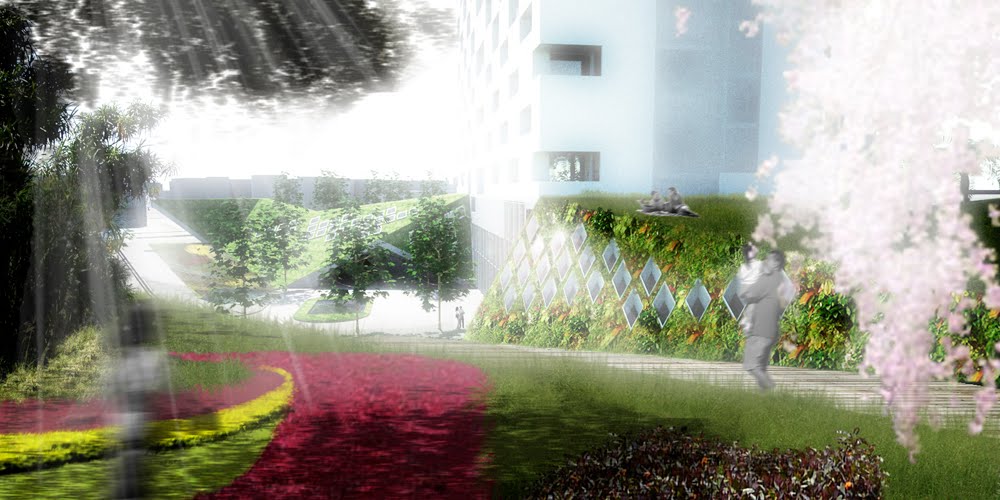
The podium transformed from an extruded, fortress-like alien block into a landscaped topography, enabling to soften the boundary to the context. The resulting space enables a landscaped roof and a more poetic experience of that landscape from below (e.g. in terms of a corridor under the pool).


The vertical courtyard concept allowed us to introduce three dimensional cavities, which create shaded, but ventilated exterior spaces, that can be used all year around, as they are protected from the direct tropical sun.


Unfortunately, the jury was looking for an easy to understand icon, so that our efforts to create a residential environment, which aimed to elevate the spatial qualities of a high density development, were irrelevant in the final judging and only good enough for a third prize.

Team: Ulrich Kirchhoff, Claudia Wigger, Louise Low, Tim Mao Yiqing, Roberto Requejo, Amy Wang

© 2009, ice - ideas for contemporary environments

Wednesday, February 24, 2010

Back to EPFL

After having taught a Masters Studio in Lausanne last Winter Term, I am very excited to go back to Switzerland in March. Giving two lectures about contemporary typologies in architecture, one at the ETH Zurich and the other one at the EPFL Lausanne, I am also looking forward to visiting the completed Rolex Learning Center by SANAA (and maybe I will be lucky to give the lecture there).

The subject of the Masters Studio was: Sustainability and Density - Contemporary Typologies in Architecture. The design project was putting emphasis on dealing with complexity: The project was a high density mixed use development in Hanoi. The complexity was not only related to the amount of program but also the climatic difference and the completely new social and cultural environment - a tough but fruitful journey for the students...


The research has been focussing on two main aspects: How density will affect typologies and their transformation in such a compact spatial scenario. And about low-tech spatial strategies for sustainability.


The purpose of this studio is to bring back a more expansive view of Architecture, to refocus energy into the larger context of living, especially in the understanding of how others live and use spaces. To simultaneously create and be created by the forces of the context, architecture is no longer an object, but also a subject in the larger scheme of things. We want to design buildings, that are not just form, but perform.
With the building boom particularily in the emerging markets, there has been a run for high density mixed-use developments. Unable to bridge the scalar gap to the existing context, we have seen a lot of brilliant solutions of self referential projects, but the overall built environment is increasingly mismanaged: Ignorant to the environment, program and climatic parameters, high density developments pose quite often severe challenges to the city, such as canyon and heat island effect, social segregation, and economic pressure. With such development pressure of iconic high density structures, architecture is produced as an object of desire, rather than a space to be inhabited and used.


Team: Ulrich Kirchhoff, Louise Low

Students: Gedeon Abebe, Esteban Becerril Pellon, Olivier Genetelli, Pablo Gironda, Riccardo Grattacaso, Marta Lopez de Aisain Gamazo, Romain Lorenceau, Marta Lozano, Mansour Noverraz, Adrien Renoult, Julie Riedo, Erika Tillberg, Toru Wada